Belgian international cooperation has sustainable human development as its main objective.
This objective must be achieved through the fight against poverty, in a spirit of partnership and with full respect for development‑relevance criteria.
It must also encourage and strengthen public support in Belgium for North–South solidarity and for our cooperation policy.
Every day, we work towards this objective — and this is also thanks to you.
Indeed, every citizen contributes to development cooperation: through taxes, through private‑sector initiatives, through donations or volunteering in an organisation active in this field, or through civic engagement in support of international solidarity.
The partnerships of the Belgian Development Cooperation
Belgian international cooperation relies on a wide range of actors, each bringing a unique added value to effectively address global challenges.
Every actor represents an essential link in the chain. This results in a coherent approach that generates a greater impact than what each actor could achieve individually, and that serves as a powerful lever for promoting stability, prosperity, and shared progress.
Governmental cooperation:
Governmental cooperation strengthens local institutions and systems in our partner countries, enabling the authorities to provide better basic services.
- With the governments of the developing countries and other donors present in the partner countries.
- Through Enabel, the international cooperation agency of the Belgian federal government. Enabel implements the Belgian policies concerning governmental development cooperation in Belgium itself and in the 14 partner countries. The agency also implements programs on behalf of other donors, such as the European Union.
- Through the Belgian Investment Company for Developing Countries (BIO), one of the key players within Belgian international cooperation in terms of local private sector financing.
Non-governmental cooperation:
Non-governmental organisations work directly with local communities and play a crucial role in strengthening civil society and promoting human rights.
The actors of non-governmental cooperation are accredited organisations. The purpose of being certified as an actor of non-governmental cooperation is to have the ability to select those organizations that guarantee subsidies are spent responsibly and efficiently.
Certification as an actor of non-governmental cooperation (ANGC) is one of the conditions for an organization to gain access to public funding for its development cooperation activities. It is obtained after favorable evaluation of the performance of the organization's management system according to well-defined conditions. The accreditation is granted for a period of 10 years and the examination to obtain it is organized every 5 years. The next examination will take place in 2026.
Currently, 94 organisations are accredited:
-
3 Federations: ACODEV, NGO-Federatie and FIABEL. They represent all certified organizations, according to their category and/or their language.
-
9 Institutional Actors (AI), these are organizations that were founded by a federal, community, regional, provincial or local government; or that are directly or indirectly monitored or managed by them.
-
82 NGO’s, these are not-for-profit organizations working in the field of international solidarity, originating from Belgian associational life. Two of them have both the ANGC recognition and are simultaneously recognized as umbrella organizations: 11.11.11 and CNCD-11.11.11
Multilateral organizations:
In our interconnected world, decisions and events on the other side of the world have an impact on Belgium. This is why multilateral cooperation is of the utmost importance, so that we can be flexible and anticipate challenges within the context of globalization. Hence, the importance of international cooperation with multilateral actors cannot be stressed enough.
The Belgian international cooperation works together with three types of multilateral partners:
-
the UN institutions and agencies;
-
the European Union;
-
the development banks.
Multilateral cooperation is a central pillar of Belgian Development Cooperation. This is in line with the government's commitment to effective multilateralism.
A complete overview of Belgian development cooperation partnerships and funding.
Humanitarian Aid
In recent years, the frequency, intensity and impact of natural disasters and complex conflict-related crises have increased. Often local – and even national – governments do not have the capacity to deal with these disasters. These crises not only create considerable physical damage, but they also weaken the affected society’s socio-economic structure and make victims dependent on external aid for long periods of time.
Consequently, Belgium is also actively involved in providing humanitarian aid, in parallel with its work in international cooperation. Although these two areas are very similar, there are major differences between them.
The goal of humanitarian aid is to provide a needs-based emergency response to save lives, alleviate and prevent human suffering and safeguard human dignity, wherever there are urgent needs and governments and local actors are overwhelmed, unable or unwilling to act.
Adhering to the humanitarian principles (humanity, impartiality, neutrality and independence) ensures that everyone in need can be helped, while protecting humanitarian actors from aiding one side in a conflict at the expense of another.
The Belgian Development Cooperation in numbers
In the ‘70s, the international community agreed that the official development assistance (ODA) of donor countries should comprise at least 0.7% of their gross national income (GNI). Belgium has legally committed itself to this target in the law of 2013 concerning the Belgian Development Cooperation. Belgium has not yet been able to reach this goal.
After a strong growth in ODA during the 2008-2010 period, with an outlier of 0.64% of GNI spent in 2010 – the highest ODA number Belgium has ever achieved, Belgian ODA gradually decreased to 0.45% in 2017. However, the EU has agreed that its member states should achieve the 0.7% target by 2030.
|
What is included in Belgian official development assistance?
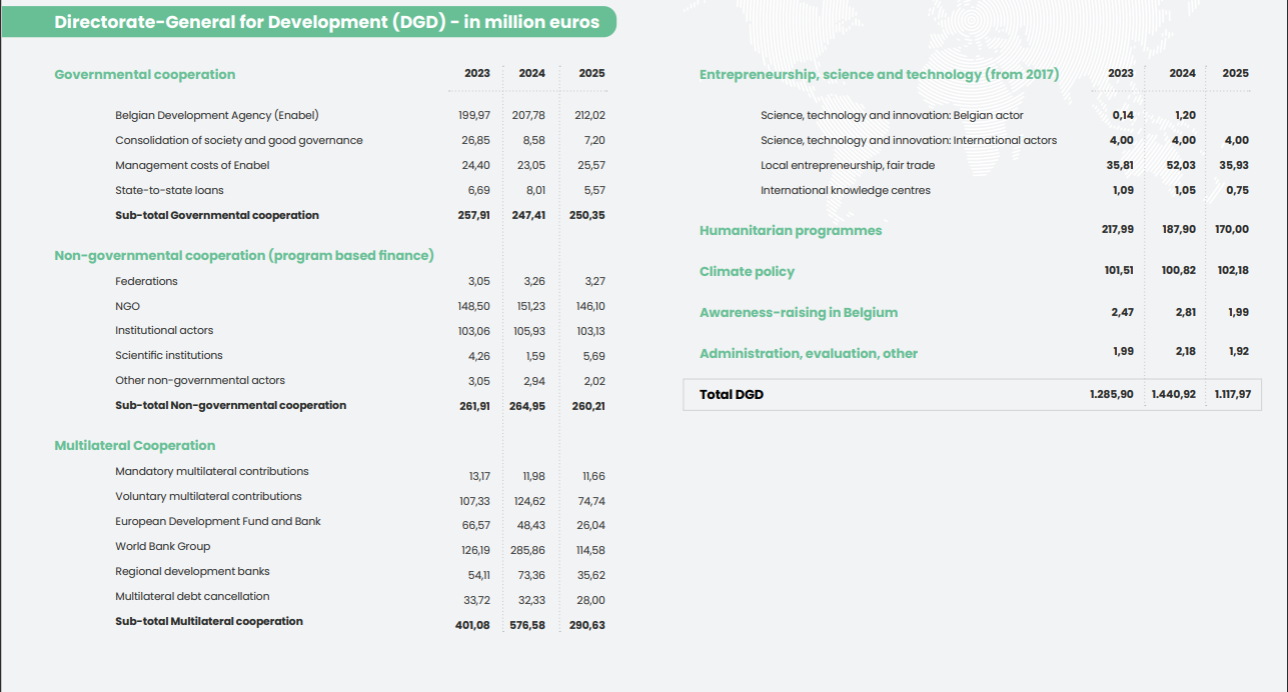
In 2025, total Belgian development aid represented about 0.37% of GNI, of which 1.117 billion euros came from DGD budgets. Belgium also spent €170 million on humanitarian aid in 2025.
|
Why transparency?
Transparency about ODA is crucial for the effectiveness of international cooperation. Hence, transparency is one of the five key elements of the Agenda for Aid Effectiveness. This idea was officially described and widely endorsed by the international community for the first time in the "Paris Declaration on Aid Effectiveness" (2005), and further developed in the "Accra Agenda for Action" (2008) and the "Busan Partnership Agreement" (2011).
To promote and realize this transparency, the ‘International Aid Transparency Initiative’ (IATI) was created in 2008 during the High-Level Forum on Aid Effectiveness in Accra, on the initiative of several bilateral donors, partner countries and NGO's.
Transparency allows donors to coordinate their efforts, avoiding overlap or gaps in international cooperation. Furthermore, partner countries can plan their budgets more effectively. Moreover, both donors and partner countries can be held accountable: by each other, their democratic representatives, civil society, or directly by citizens.
What can you find on this data portal?
On this site you will find all projects, programs, international contributions, humanitarian aid, or other expenditures that are part of the official Belgian Development Cooperation since 2014, included in the budgets of the Directorate General for Development Cooperation and Humanitarian Aid (DGD).
In addition, we propose various "Stories", selected because of their innovative approach, or because they illustrate the priorities of policymakers, or because they show how to come up with creative solutions in difficult circumstances.
The Belgian development policy focuses primarily on the poorest countries. These countries often suffer from unstable or even non-existent state structures, making it difficult to achieve sustainable human development. To support sustainable development, Belgium tries to make a difference through its partnerships, despite the scarcity of resources.
We will regularly update our selection of illustrative stories. You can find them on the "Stories" page.
Practical remarks
On the "Projects" page, activities supported by the DGD from 2014 onwards can be found, using (a combination of) the following parameters: partner country, sector, implementer. Many projects support a partner country as a whole, such as the modernization of education or agriculture ministries for instance.
Furthermore, general contributions (core funding) to international aid organizations, such as the Red Cross or UNICEF, cannot be linked to specific countries. This also applies to awareness-raising projects that provide information to citizens, or general research on development in universities or other research centers.
To provide a complete and accurate overview of our international development cooperation, the general contributions to international organizations have been divided by sector.